



from 40 Questions About the Trinity
by Matthew Y. Emerson & R. Lucas Stamps
The doctrine of the Trinity can be taxing on the limits of human understanding. As the church has sought to interpret and synthesize the biblical teaching on the Trinity and to defend it against error, it has found the need to use technical vocabulary: essence, person, missions, processions, inseparable operations, perichoresis, appropriation, and so on. Even if we restrict ourselves to the biblical language, many paradoxes emerge. How can God be one (as both the Old and New Testaments consistently maintain) and yet each of the divine persons—Father, Son, and Holy Spirit—be equally and eternally God? How can the Son be one with the Father and yet eternally generated from him? How can the Spirit be identified as the same Lord and yet eternally proceed, or come forth, from the Father and Son? Despite the difficulty, the doctrine of the Trinity simply cannot be shelved as an interesting but ultimately unknowable theological truth that is best left to the experts. The doctrine is too important to Christian faith and practice. The Trinity is not graduate-level Christianity; it is Christianity 101. We begin our Christian pilgrimage by being immersed into the triune name (Matt. 28:19). We continue in the journey by being assured of the Trinity’s saving work (Eph. 1:3–14) and by walking in a manner of our calling by one Spirit, one Lord, and one God and Father of all (Eph. 4:1–6). And we find our journey’s end in the bliss of eternal life, which is to know the one true God and Jesus Christ whom he has sent through the work of the Helper who is sent from them both (John 15:26; 17:3). As one author put it, those who advance most in the Christian life are those who never leave the beginning: our baptism in the triune name.[1]
In order to explain this mystery, many well-meaning preachers, teachers, and parents have sought out analogies as a teaching tool. Is God like the water molecule, which can be present in three different states: liquid, vapor, and solid? Or like an egg, which is one thing with three different parts: the shell, the white, and the yolk? All analogies break down, and some analogies do more harm than good by yielding, however unintentionally, heretical conclusions. But if we cannot make use of analogies, how then should we teach the doctrine of the Trinity? In this chapter we will examine the limits of Trinitarian analogies, and in question 39 we explore more fruitful means of teaching this most foundational Christian doctrine.
Historic Trinitarian Analogies
As we stated above, many turn to analogies in order to explain the doctrine of the Trinity. Some analogies are better than others in explaining certain aspects of the doctrine, if not the doctrine as a whole. For example, some of the church fathers used the analogy of the sun and its light in order to explain how the Father is never without his Son. In this vein, Athanasius writes,
So again we see that the radiance from the sun is proper to it, and the sun’s essence is not divided or impaired; but its essence is whole and its radiance perfect and whole, yet without impairing the essence of light, but as a true offspring from it. We understand in like manner that the Son is begotten not from without but from the Father, and while the Father remains whole, the Expression of His Subsistence is ever, and preserves the Father’s likeness and unvarying Image, so that he who sees Him, sees in Him the Subsistence too, of which He is the Expression.[2]
Athanasius opposes here the Arian notion that the Son’s generation entails his creation. If the Son is eternally generated from the Father, then would this imply that the Father’s essence was somehow divided or partitioned in order to produce the Son? Athanasius appeals to the sun and its radiance as an analogy. It is of the essence of the sun to produce light, and this is in no way divides the essence of the sun; rather, the essence of the sun is preserved whole and intact in the radiance such that one who sees the light of the sun sees the sun itself. In a similar manner, the one who sees the Son sees the Father from whom he is generated. We might extend the analogy to the Holy Spirit as well, if we consider that the sun’s essence is also expressed in its heat. The analogy, of course, can be pressed too far, especially if used to subordinate the Son and Spirit to the Father. Still, the analogy gives us a way of conceiving the coeternality of the three persons. Something like this analogy is even expressed in the creedal line: “light from light.”
Another analogy comes from Gregory of Nyssa in his important treatise, On “Not Three Gods.”[3] Here Gregory compares the three persons of the Trinity to three human persons, who each share in the essence of humanity. The kind of essence that three human beings share is the same, but they each represent a distinct instantiation of that essence. But again, the analogy is imperfect, which Gregory readily admits (his book is, after all, seeking to demonstrate that Christians do not believe in three gods). The analogy to three humans breaks down because God is not, strictly speaking, one of a kind. The being of God is not a kind essence that is capable of multiple instantiations. The being of God is simply and essentially one. Three human persons share a common kind (human nature), but they do not share a common being, or substance. The three divine persons, on the other hand, share the identically same divine nature; they each are the very same being.
As we saw in our chapter on Augustine, the great North African theologian sees the image of God in man as the best place to search for a meaningful Trinitarian analogy. In his influential work De Trinitate, Augustine develops a series of so-called psychological analogies in order to contemplate the Holy Trinity.[4] As memory/understanding and will/love emanate from mind, so too the Son and Spirit proceed from the Father. Thomas Aquinas, Jonathan Edwards, and others follow Augustine in developing these analogies from human psychology. Augustine’s analogies have the advantage of following key biblical themes. The Son is, after all, referred to in the New Testament as the Word and Wisdom of the Father. The Spirit is also closely associated with the themes of love and gift that Augustine sees entailed in the human will. But psychological analogies also break down because they are drawn from a single person, namely, a human person. Memory and will can be distinguished from mind in an individual human, but they do not constitute distinct persons. Like the sun/light/heat analogy, the psychological analogy when taken to the extreme can yield a modalistic picture of the triune God.
Popular Trinitarian Analogies
In addition to these historic analogies, Christian teachers are sometimes drawn to other, more popular analogies like the ones mentioned in the introduction to this chapter. The commonplace water analogy seems straightforwardly modalistic. Water can exist in the three states of matter under different conditions, but it is not so at the same time and under the same conditions. Indeed, most of the popular analogies tend toward modalism. Some suggest that the Trinity is like different roles that a person can have: a mother, a daughter, and a sister. But these roles describe the contingent relations of a single person, not really existing “relations of opposition” (to use Thomas Aquinas’s term) that obtain eternally between the three divine persons. Other analogies reduce Father, Son, and Holy Spirit to three parts of a whole rather than three persons in the Godhead. The parts of an egg or an apple or the three leaves on a clover fall into this error. But if the divine persons are each simply a part of a larger whole that is God, then it turns out none of them is truly and fully God in himself.
Summary
In short, even the best analogies on offer in the history of doctrine break down in some important ways, and the popular contemporary analogies tend in a more obviously heretical direction. In our teaching on the doctrine of the Trinity, we often point out the deficiencies of these analogies to the Trinity. The obvious question that most students ask then ask is, how then do you explain the doctrine of the Trinity, especially to new believers, inquirers, or even to children? The next chapter explores some ways to introduce the doctrine of the Trinity in our preaching and teaching.
[1] Ben Myers, The Apostles’ Creed: A Guide to the Ancient Catechism (Bellingham, WA: Lexham, 2018).
[2] Athanasius, Four Discourses against the Arians, 2.33 (NPNF 2 4:366).
[3] Gregory of Nyssa, On “Not Three Gods” (NPNF 2/5:333–36).
[4] Augustine, The Trinity, 2nd ed., trans. Edmund Hill, ed. John Rotelle, The Works of Saint
Augustine 5 (Hyde Park, NY: New City, 2012).
This post is adapted from 40 Questions About the Trinity by Matthew Y. Emerson & R. Lucas Stamps. This title was released on September 30, 2025. If you are interested in adopting this book for a college or seminary course, please request a faculty examination copy. We will also consider requests for your blog or media outlets.
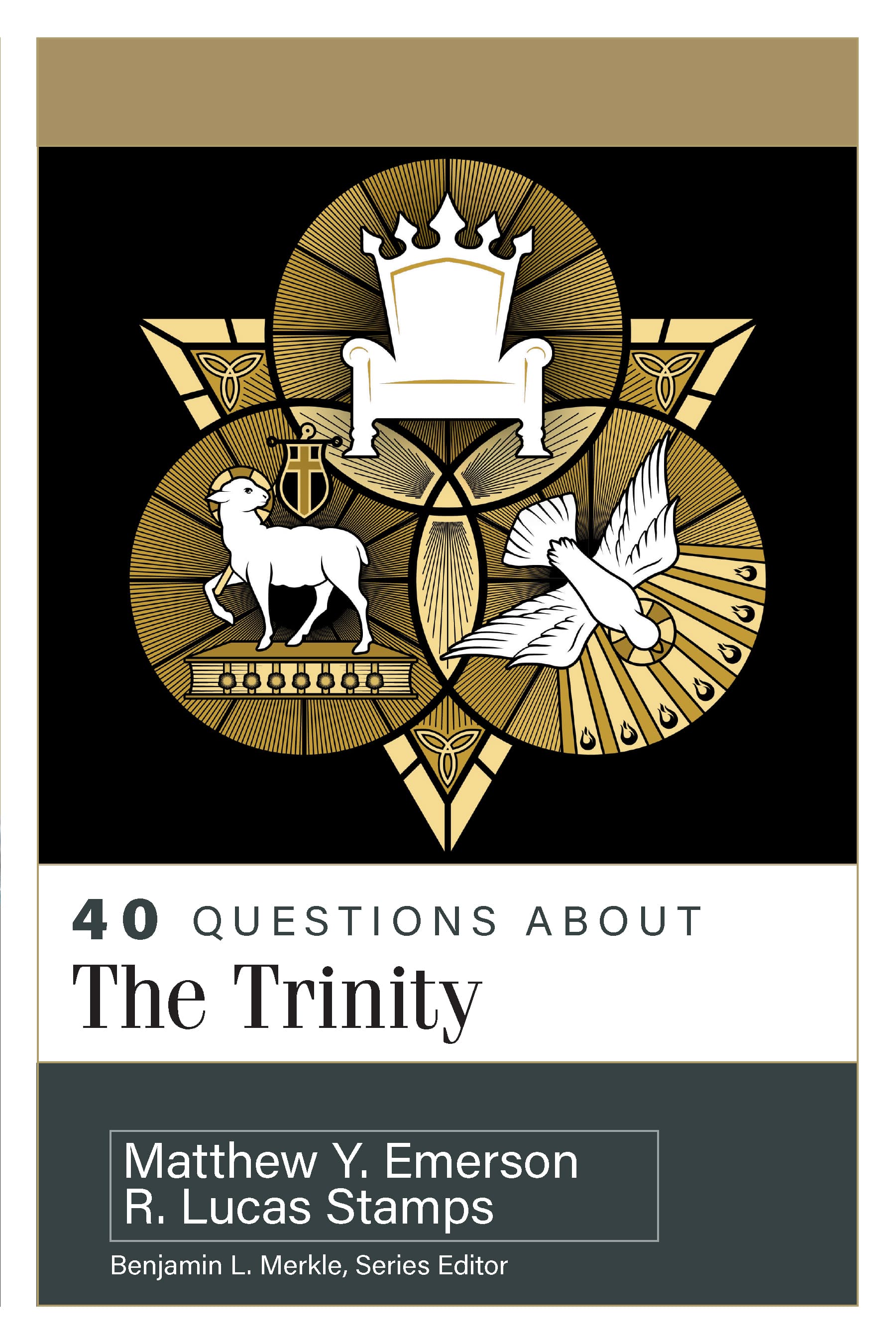 Trinitarian theology sits at the heart of Christian doctrine, yet how many believers understand this foundational truth of the faith? Perhaps more importantly, how many believers understand what is at stake in holding to a biblical understanding of this core tenet of the faith? In this primer on Trinitarian theology, readers are invited to ask forty pertinent questions about Trinitarian theology, including:
- What Is the Trinity?
- Why Is It Important for Christians to Know the Doctrine of the Trinity?
- What does the Bible Teach Us About the Trinity?
- What Happened to the Trinity at the Cross?
- How Do We Apply the Doctrine of the Trinity to the Christian Life?
Ultimately, questions about the Trinity are questions about God. Taking the time to prayerfully explore and answer such questions will lead one to a deeper knowledge of him. 40 Questions About the Trinity provides helpful and encouraging guidance for this endeavor.
Authors:


